


Note: Hey all. Thanks to Claude (with me in the loop), the AI blog version is back again. All of it is derived from the podcast — which goes deeper if you’re so inclined.
We’re into Part 3 of “The One Thing” by Gary Keller and Jay Papasan — and this section is called Extraordinary Results: Unlocking the Possibilities Within You. Today we’re covering the first three chapters: Live With Purpose (the why), Live by Priority (the what), and Live for Productivity (the how).
This post stands alone — no book required, no previous episodes needed.
The book opens this section with a line I keep coming back to:
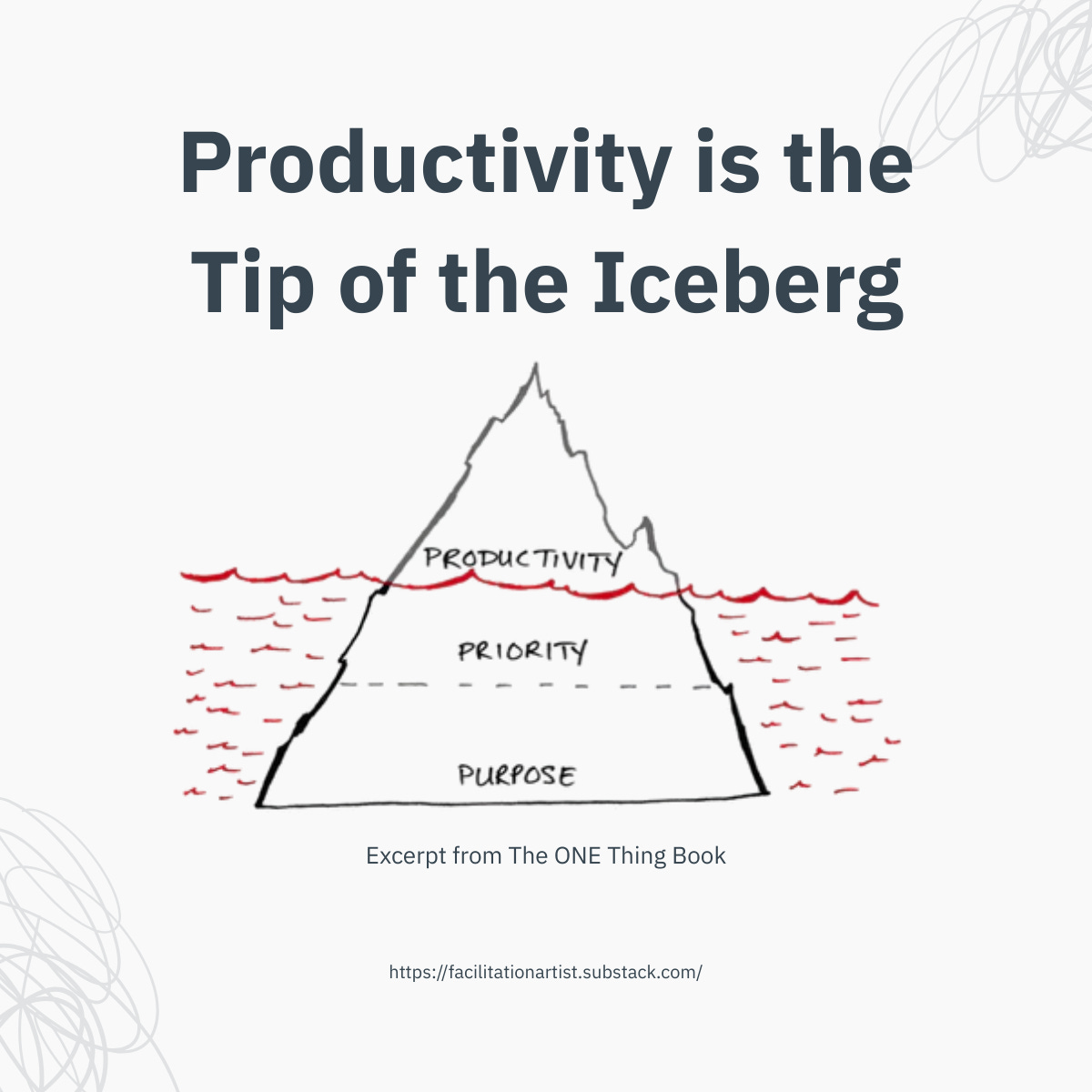
“There is a natural rhythm in our lives that becomes a simple formula for implementing The ONE Thing and achieving extraordinary results: purpose, priority, and productivity. Bound together, these three are forever connected.”
They illustrate this with an iceberg. Above the waterline — what everyone sees — is your productivity. Your output. Your results. But underneath, holding the whole thing up, is purpose and priority. When I work with leaders chasing growth, this is exactly what I see. We can’t just talk tactics and output. We have to go below the waterline first.
Chapter 13: Live With Purpose (The Why)
This chapter opens with a George Bernard Shaw quote that honestly feels like the mantra for this whole podcast:
“Life isn’t about finding yourself. Life is about creating yourself.”
Real transformation comes from doing — from creating — not from passively consuming. I watch people get paralyzed by information overload all the time. They read everything, listen to everything, and still don’t move. We’re here to create, not just to consume.
As a facilitator, I understand that “why” is important, and I often use the Five Whys. You keep asking why (often 5 times) until you get to the root. Whatever your surface goal is — losing weight, getting a promotion, growing your business — when you trace it back far enough, it almost always comes down to happiness. And the book puts it beautifully: “happiness happens on the way to fulfillment.” The journey is the goal.
Here’s where it gets practical. A lot of people get completely stuck trying to find the perfect purpose. The book’s take on this is refreshingly direct: time brings clarity. Pick something, go forward with it for a while. You can always change your mind.
Don’t make finding your purpose your new form of procrastination. Give yourself permission to start somewhere.
Chapter 14: Live by Priority (The What)
This chapter opens with a quote that’s been living in my head since I read it:
“Planning is bringing the future into the present so that you can do something about it now.”
This hit me hard because so much of my work — in higher education, in product — is about taking massive strategic plans and making them actually actionable in the present. Long-term planning is only useful if it creates a priority you can act on today.
And here’s the historical nugget from this chapter that I think about constantly: the word “priority” didn’t used to be plural. There was no such thing as “priorities.” There was just priority — the one thing that mattered most. Somewhere along the way we started pluralizing it, and now we need modifiers like “top priority” or “first priority” because the word alone doesn’t carry enough weight anymore.
I see this constantly. Someone will come to me with six priorities across their product portfolio. My question is always the same: if you could only run one campaign and put all of your eggs in one basket — which one would it be? It drives people crazy. But it’s the most important question you can ask.
The book maps this visually — how your priority for right now cascades all the way up to your someday goal. Your ONE daily thing is your first domino. Identify it correctly and it starts knocking everything else over.

Chapter 15: Live for Productivity (The How)
This is the meatiest chapter, and honestly, the one that changed how I work. Rereading it, I kept having this moment of recognition: oh, this is where I got that from.
The big distinction here comes from Peter Drucker:
“Efficiency is doing the thing right. Effectiveness is doing the right thing.”
You can be incredibly efficient at the wrong things. This chapter is about being effective — focused on what actually moves you toward extraordinary results.
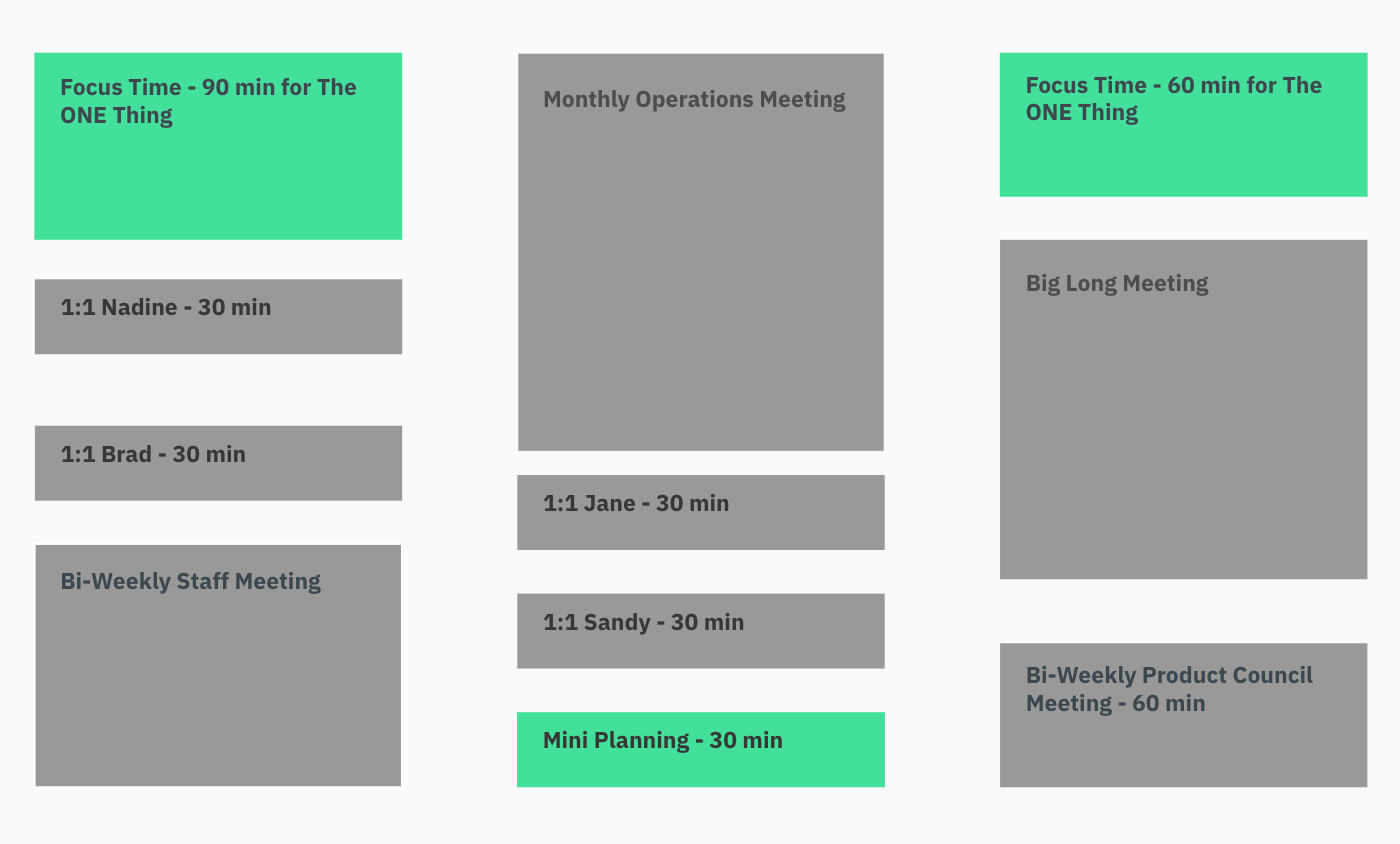
The book’s recommendation: “your ONE thing deserves four hours of protected focus time per day.” I know that sounds like a lot — especially if you’re in a corporate role with a calendar full of back-to-back meetings. I work 25 hours a week in my corporate role and don’t always hit four hours of focused time on my personal work. But the principle holds: the more protected focus time you give your ONE thing, the faster you build toward extraordinary results. Less time means slower progress — and that’s honest, and that’s okay.
One quote from this chapter that I keep returning to, especially for those of you who are managers or team leads:
“To experience extraordinary results, be the maker in the morning and the manager in the afternoon.”
When I was managing a team, this is exactly what I did. I stacked all my one-on-ones in the afternoon, on the same day, as much as possible. By then my creative energy was spent — but I could be fully present, a good listener, receptive to what people needed. I protected my mornings for the work only I could do.
Three Things to Time Block
The book gets very specific here. In order of priority:
Block your time off first. Rest and vacation go on the calendar before anything else. Build your productivity around your life, not the other way around.
Block your ONE thing. This is your protected focus window. Even if it’s only 20 minutes on some days — block it. Defend it. Don’t let it be the first thing that gets negotiated away.
Block planning time. 30 minutes to an hour each week to review your goals — annual, monthly, weekly — and reconnect with what your ONE thing actually is.
That third one is something I built directly into my Deep Work Days course as the Friday Workbox practice. I review my OKRs, figure out what cascades to the week, set my ONE thing, and decide what I’m going to say no to. It’s one of the most consistently valuable habits I have.
The Big Takeaway
Purpose is your compass. Priority is what you act on. Productivity is the disciplined practice of protecting time for the things that matter most.
The three together:
Start with your why — not the surface answer, the real one. Do the Five Whys if you need to.
Identify the ONE priority that moves everything else. Not a list. One.
Protect that time. Block it. Defend it. Build your day around it.
As the book says: “there’s a magic in knocking down your most important domino day after day.” Small, consistent, intentional actions compound into something extraordinary over time. The “overnight success” you admire in someone else almost always came from exactly this — one thing, every day, on purpose.
Next week: We’re finishing Part 3 — the Three Commitments and the Four Thieves. These chapters are about what it actually takes to stay on the path once you’ve found it. See you then. 🎯


